For most warehouses, garages, repair shops, and office spaces across Quebec, the 4-foot T8 fluorescent tube has been part of the ceiling for so long that nobody questions it anymore. The tubes flicker, the ballasts hum, and every couple of years someone climbs a ladder to swap a burned-out lamp. According to Hydro-Quebec’s business energy-efficiency programs, lighting accounts for 15 to 30 percent of total commercial electricity use, which means the habit of replacing fluorescent tubes instead of upgrading the technology can quietly add thousands of dollars to the annual operating budget of any business.
What has changed quietly over the past decade is the maturity of the LED replacement market. Tubes have moved past the early-generation problems of poor colour rendering and short life expectancy, and the swap is becoming simpler than ever for property managers and electrical contractors. Anyone considering a retrofit can start by browsing Speclite’s LED T8 retrofit lineup to see how far the technology has come.
The True Cost of Keeping Your T8 Tubes
The sticker price of a fluorescent tube has fooled business owners for decades. At three or four dollars per tube, it looks like the cheapest option on the shelf. But the real cost is everything that happens after the lamp is installed in the fixture.
Energy draw is the largest hidden expense. A standard 4-foot T8 tube uses 32 watts of light-producing power, but the ballast that drives it draws an additional 4 to 10 watts as a parasitic load. Across dozens of tubes burning 10 to 14 hours a day, the kilowatt-hours add up quickly.
Ballast failure is the second invisible expense. The internal transformer eventually fails between the seven- and ten-year mark, and the labour to replace one runs 80 to 150 dollars per fixture. Mercury disposal is the third: federal regulations under the Canadian Environmental Protection Act prohibit throwing fluorescent tubes in regular trash, which adds 0.50 to 2 dollars per tube on top of the replacement cost.
The Hidden Headache of Choosing the Right Replacement
Anyone who has actually shopped for LED T8 replacements knows the catch: it is almost never just one tube. The market is fragmented into a dozen incompatible formats, and picking the wrong one means a frustrating return trip to the supply house or a midnight call to an electrician.
Wiring is the first variable. Single-ended tubes need line and neutral on the same end of the socket, while dual-ended tubes expect them on opposite caps. Ballast compatibility is the second: some buildings still have functioning electronic ballasts, others have already had them removed for direct wiring, and most LED T8 tubes work with only one configuration. Voltage is the third trap, with office spaces typically at 120 V, commercial buildings often at 277 V, and industrial spaces sometimes at 347 V. Layered on top come colour temperature and wattage choices, and stocking all of these as separate SKUs becomes the modern version of the fluorescent ballast nightmare.
One Engineered Solution to the SKU Problem
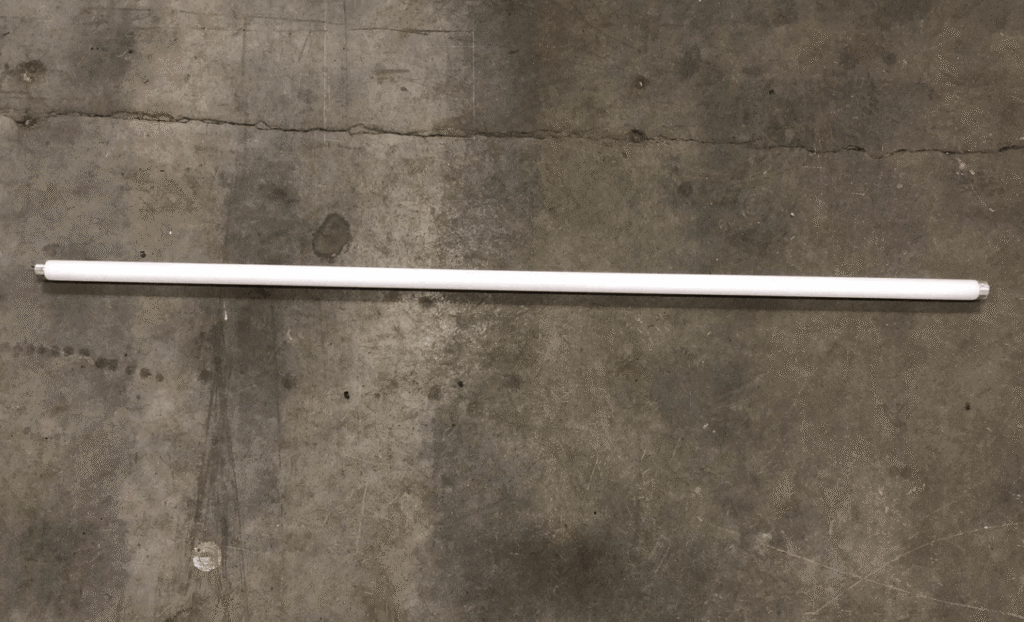
A newer generation of Quebec-engineered LED T8 tubes is designed to eliminate the SKU chaos entirely. Speclite’s universal tube, for instance, accepts both single-ended and dual-ended wiring, works with or without an existing ballast, handles input voltages from 120 to 347 V, ships with six selectable colour temperatures from 2700K to 6500K, and offers six wattage levels from 10 W to 22 W. The math works out to 432 distinct configurations covered by a single shelf SKU, allowing a contractor to walk into virtually any T8 retrofit job without a second trip to the supply house.
The full aluminum chassis is the other quiet upgrade. LED chips are sensitive to heat, and every ten degrees of junction temperature above the design point can cut their rated lifespan in half. The plastic bodies common on bargain imports trap that heat against the chip. A continuous aluminum heat sink pulls the heat away from the diode and keeps the junction temperature stable, so the tube actually delivers its rated lifespan in a Quebec garage that swings from minus twenty to plus thirty Celsius across the year.
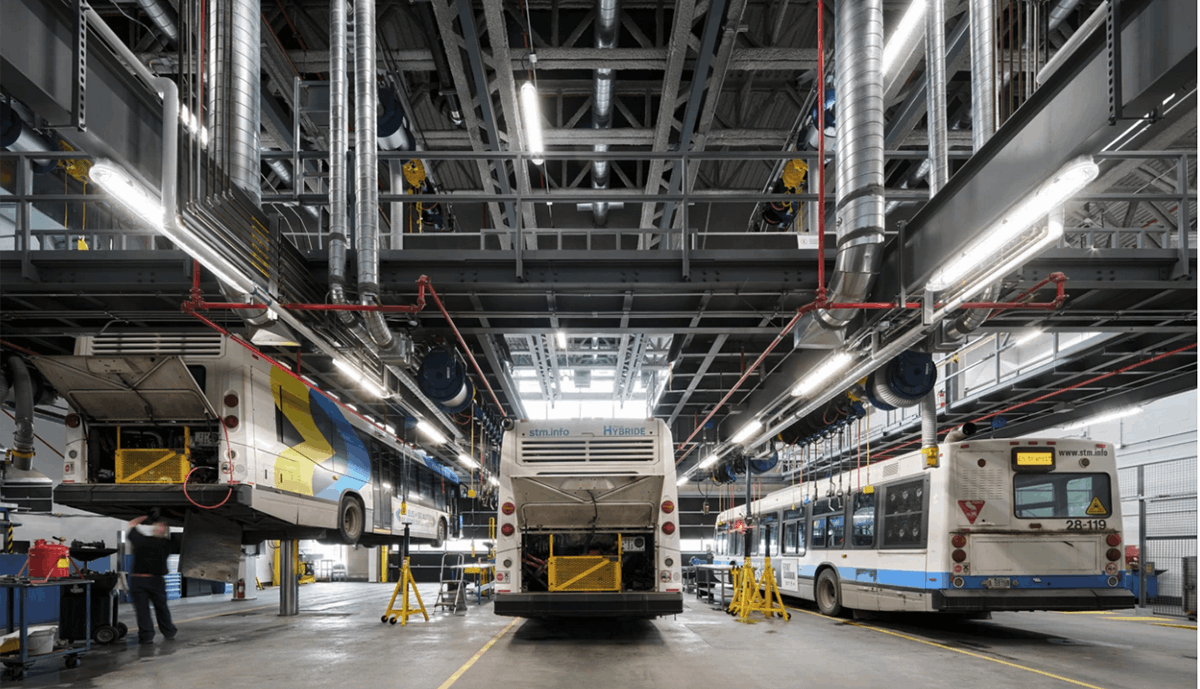
The same engineering choices have already been validated in one of the toughest operating environments in the province. The Société de transport de Montréal selected Speclite tubes to light its entire train fleet through a competitive public bid, with cars subjected to constant vibration, deep cold in winter storage yards, summer heat inside metal bodies, and the harsh chemical agents used in fleet cleaning. A tube that supports that service profile will more than hold up in a warehouse, garage, office, or retail floor.
Real Numbers: A 20-Fixture Workshop in Montreal
Numbers always land harder than theory, so consider a small Montreal automotive workshop with 20 ceiling fixtures, each holding two 4-foot T8 tubes. The shop is open six days a week, ten hours a day, which works out to roughly 3,000 operating hours per year.
The existing fluorescent system uses 40 tubes at 32 watts each, plus 20 ballasts, adding roughly 8 watts of parasitic draw per fixture. Total system load comes to about 1,440 watts. Over 3,000 hours, that is 4,320 kilowatt-hours per year. At Hydro-Québec Rate G commercial pricing of roughly 0.10 dollars per kilowatt-hour, the annual energy bill for lighting alone is around 432 dollars.
Swapping in 40 LED T8 tubes at 18 watts each, with the ballasts bypassed, drops the load to 720 watts. That is 2,160 kilowatt-hours per year, or roughly 216 dollars in electricity. Layered onto the energy savings is the disappearance of routine tube and ballast service, roughly 150 dollars per year in parts, labour, and mercury recycling. Total combined savings sit at 350 to 380 dollars per year, with a payback period of about two years.
Fluorescent T8 vs Modern Universal LED T8
The table below puts the two technologies side-by-side on the criteria that actually matter to a Quebec property owner or electrical contractor evaluating a retrofit.
| Criteria | T8 Fluorescent | Universal LED T8 |
|---|---|---|
| Wattage per tube | 32 W + 4-10 W ballast draw | 10 to 22 W selectable |
| Colour temperature | Fixed per tube | 2700K to 6500K, 6 options |
| Voltage input | Fixed at 120 or 277 V | 120 to 347 V universal |
| Wiring | Fixed by ballast type | Single or dual-ended |
| Ballast compatibility | Requires matching ballast | Works with or without |
| Body material | Glass, mercury inside | Full aluminum heat sink |
| Lifespan | 15,000 to 20,000 hours | 50,000 hours and up |
| Cold-start performance | Slow, flickers below 0 C | Instant output, any temperature |
| Mercury content | 3 to 5 mg per tube | None |
The Quiet Shift on Montreal Ceilings
Fluorescent tubes still light rooms, but they no longer make financial or operational sense in a province where electricity is metered, mercury disposal is regulated, and every retrofit job once required a different replacement model. The move toward engineered universal LED T8 tubes is happening one ceiling at a time across Montreal, with payback periods often under two years and the welcome side benefit of eliminating the inventory headache that came with traditional retrofit projects.