Amazon has merged its advertising tools into one AI-powered platform. Here is what it changes for brands selling on Amazon.ca.
For many Canadian businesses, Amazon is no longer just a marketplace. It is one of their biggest advertising channels. At its unBoxed conference on September 29, 2026, Amazon announced Amazon Ads Agent, the new name of its unified advertising platform, now powered by what Amazon calls agentic AI.
If you sell on Amazon.ca, or are thinking about it, here is what you need to know.
The timing matters. Competition on Amazon.ca keeps growing, with more brands, more sellers from abroad and higher costs per click in many categories. At the same time, many small Canadian sellers still manage their ads by hand, in spreadsheets, a few hours a month. Amazon’s new platform is clearly designed to change that, by letting its AI do more of the planning and optimisation. Used well, it can save time and open new audiences. Used blindly, it can spend a lot of money quickly.
One platform, three campaign types
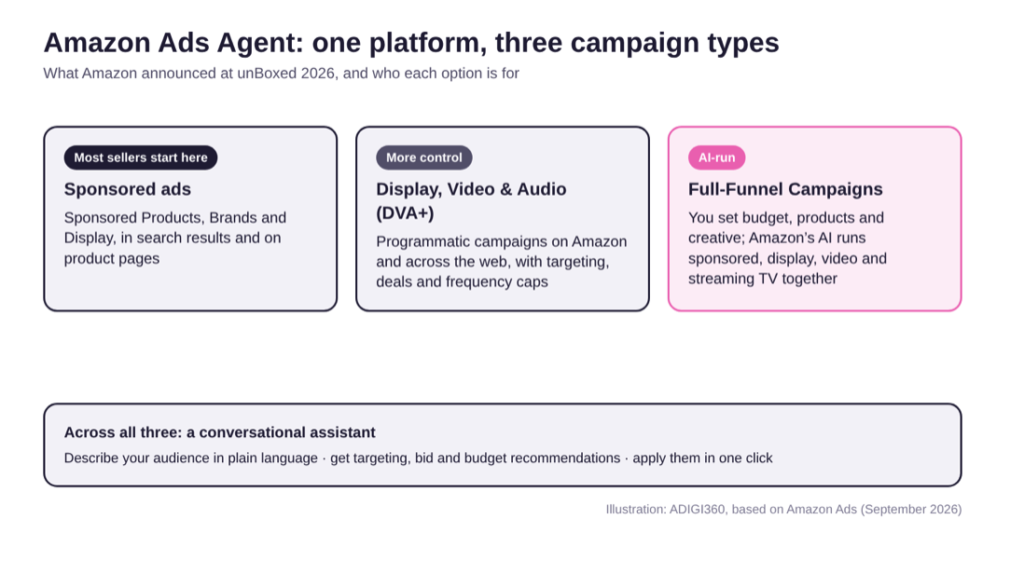
Amazon Ads Agent brings together what used to be separate tools: the Ads Console, where most sellers run Sponsored Products, and the Amazon DSP, used for display and video. It now offers three campaign types:
- Sponsored ads: Sponsored Products, Sponsored Brands and Sponsored Display, the ads most sellers already use in search results and on product pages.
- Display, Video and Audio (DVA+): programmatic campaigns across Amazon’s sites and the wider internet, with targeting, deals and frequency caps.
- Full-Funnel Campaigns: you provide a budget, products and creative, and Amazon’s AI plans and runs sponsored ads, display, video and streaming TV together, with reporting on new-to-brand customers and long-term sales.
Availability varies by country and some features start in beta in the United States, so check what is open for your Amazon.ca account.
An AI assistant inside your ad account
The most visible change is the conversational assistant. Sellers can describe the audience they want to reach in plain language and get targeting recommendations across products, categories, keywords and Amazon audiences. The assistant also suggests changes to bids, budgets and targeting for Sponsored Products, which can be applied in one click.
Amazon reports that advertisers who applied its natural-language targeting recommendations reached more than 25% more unique customers, while lowering their cost per impression by more than 10% on average.
What to keep under control
AI can save time, but it optimises for the goal you give it. Before you let it run your budget, make sure you control the basics:
- Margins by product. Know which products can afford advertising and which cannot. A high return on ad spend on a low-margin product can still lose money.
- Brand versus non-brand spend. Ads on your own brand name are cheap and convert well, but they mostly capture customers who were already looking for you. Growth comes from non-brand searches and new audiences.
- Product pages. Titles, images, A+ content, reviews and stock levels decide whether a click turns into a sale. No AI can fix an empty listing.
- New-to-brand metrics. Use them to see whether your campaigns are finding new customers or just reselling to existing ones.
An example: a Canadian home goods brand
Picture an Ottawa-based brand selling kitchen storage on Amazon.ca. Its Sponsored Products campaigns mostly target its own brand name and a few exact keywords. Sales are steady, but growth has stalled.
With Amazon Ads Agent, the team can ask the assistant to find shoppers interested in small-kitchen organisation, compare suggested keywords and categories with their margins, and test a Full-Funnel Campaign to reach people who have never bought from them. The new-to-brand report then shows whether the extra spend actually brings new customers.
Common mistakes to avoid
- Applying every AI recommendation without checking margins.
- Letting brand campaigns take most of the budget and calling it growth.
- Launching video or streaming TV before product pages are ready.
- Comparing Amazon results with other channels without looking at long-term sales.
Where to start
- Clean your top listings first: titles, images, price and stock.
- Run Sponsored Products on your best sellers with a clear target cost of sale.
- Use the assistant to find new targeting ideas, then review them before applying.
- Test Full-Funnel Campaigns once your basics are profitable and you want to reach new customers.
Amazon’s new tools make advertising easier to launch, but not easier to make profitable. Sellers who combine Amazon’s AI with clear margins and solid product pages will get the most out of it. That is the approach ADIGI360, a Canadian performance marketing agency, takes with the brands it supports on Amazon, Google and Meta.
contributed post