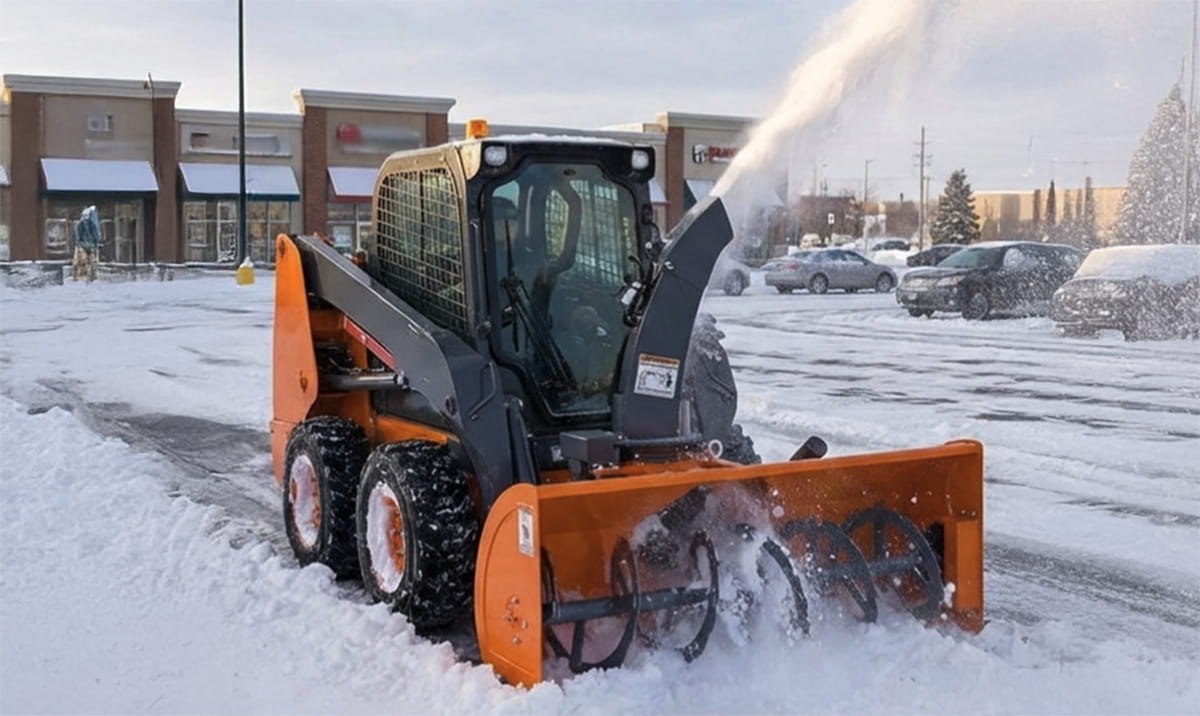
When a lot, a farmyard, or a long laneway is too big for a pickup plow, owners often turn to the loader they already have. A skid steer snow blower is an attachment that borrows the loader’s hydraulic power to chew through snow and throw it clear, which is useful anywhere there is nowhere nearby to pile it. How well it works comes down to three things: how the oil drives the machine, how the auger and impeller share the work, and whether the attachment suits the loader carrying it.
Why Large Properties Need an Attachment Machine
A plow pushes snow aside, and that works until the banks grow tall enough to block the lot. A blower throws the snow away, often tens of feet, so a loading dock, a parking row, or a farm lane stays open, which is a real advantage when a storm leaves little room for banks. Because the blower is an attachment, one loader can do snow removal in winter and other work in summer, which spreads the cost of owning the machine across the year.
Sizing the Job Before the Storm
The first step in snow removal is knowing the area. Walk the site and note the parking rows, loading zones, fire lanes, and the places where wind drops drifts. A wide blower clears more per pass but needs a loader that can carry it, while a narrower unit works better in tight lots. Planning a route that finishes each pass at the discharge point cuts time, since a skid steer snow blower is most efficient when it travels in long, straight lines rather than in short, turning loops.
How the Hydraulic Drive Works
The blower has no engine of its own. A skid steer carries an auxiliary hydraulic circuit, a pump and a pair of hoses, that sends pressurized oil to a motor on the attachment. Flow, measured in gallons per minute, sets how fast the motor turns, while pressure sets how hard it can push against the load. A garden hose is a fair picture: a wider stream moves more water, and a narrowed nozzle raises pressure.
The loader’s hydraulic flow must match what the attachment needs. Too little flow and the impeller spins slowly and throws snow a short distance, while too much can overheat the oil. Checking both numbers in the manuals before buying is the most important step.
Auger and Impeller Working Together
A two-stage blower divides the job. The auger is a rotating steel screw with serrated teeth that break up packed snow and ice and pull it toward the center. The impeller is a fast-spinning paddle wheel that picks up that snow and sends it up the chute. Think of a person who loosens a drift with a pick and then sweeps it away with a shovel, with the two jobs done in one pass.
Wet snow is the hard case, because it is heavy and sticky and tends to pack the chute. A slower ground speed lets the auger keep up, and a clear chute throws farther. Spraying the inside of the chute with a silicone-based lubricant before a storm helps wet snow slide out instead of sticking.
Matching the Blower to the Machine
A heavy attachment hangs out in front of the loader, so it shifts weight onto the front axle and lightens the rear. Check that the loader’s lift capacity and weight suit the blower, and keep the load low while traveling so the machine stays stable. Tracks or tire chains help on ice, because a loader that spins its wheels with a blower in front is working harder than it needs to.
Planning the Route Across a Large Lot
Skid steer snow removal goes faster with a plan. Start along the edge where the snow will be thrown, then work back and forth so each pass overlaps the last by a few inches. Leave space beyond the bank for the next storm, and avoid throwing snow onto the lane that must be cleared again. A snow blower for skid steer use throws a long distance, so wind direction decides which side to start from.
Steering the Snow
A hydraulic motor usually rotates the chute, which lets the operator aim the discharge without leaving the seat. The rule is to throw with the wind or across it, and away from buildings, vehicles, and neighboring property. Planning where the snow will land before the first pass prevents a second job of moving it again.
Compared with a Pusher or a Bucket
Each attachment suits a different situation. A pusher moves snow a short distance and is fast on a wide, open lot. A bucket carries snow to a pile. A blower removes it from the area entirely, which matters on a site with limited space. Many operators keep two of the three, using the one that fits the snowfall and the site.
Protecting the Surface
Skid shoes, the metal plates under the housing, set how close the cutting edge rides to the ground. On pavement they can be lowered for a clean scrape, while on gravel they should be raised so stones are not drawn in and thrown at speed. A blower set too low can damage a surface and the machine at the same time.
Cold Oil and Winter Starts
Hydraulic oil thickens in freezing weather and moves slowly until it warms. Letting the loader idle for a few minutes before engaging the blower protects the pump and hoses, and cycling the controls gently warms the system. Keep the quick couplers clean and capped when not in use, because ice and grit in a coupler can lock it or contaminate the oil. Wiping each coupler before connecting it takes seconds and prevents a failure that could stop the machine in the middle of a storm.
Staying Clear of the Discharge and Moving Parts
A few rules apply every time:
- Stop the engine before clearing any blockage
- Use a clearing tool, never a hand
- Keep bystanders well back from the discharge
- Check that guards and hoses are secure
Maintenance and Storage
After each storm, inspect hoses for rubbing, check fasteners, and grease the fittings. Keeping a simple log of hours and repairs helps spot a pattern before it turns into a breakdown. A hose that leaks under pressure can inject oil through skin, so a suspected leak should be found with the machine off and never with a bare hand. At season’s end, clean the housing, touch up bare metal, and store the attachment off wet ground so it is ready for the next heavy snowfall.